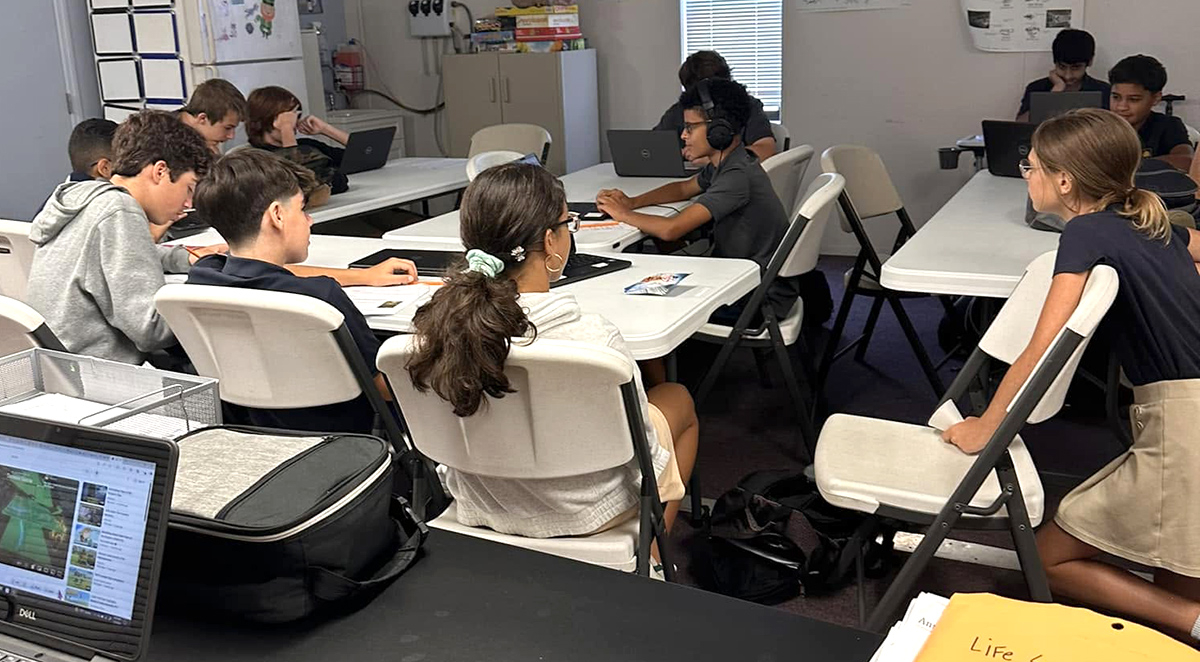
Does the number of students in a room change what a child learns? This is among the most studied questions in American education, and it has been genuinely contested for forty years. What follows is a look at the major studies, including the ones that complicate the case for smaller classes.
Quick Summary
- Project STAR, a randomized experiment in Tennessee, found measurable achievement gains for students placed in classes of 13 to 17 students.
- Long-term follow-up linked small early-grade classes to higher college attendance, with the largest gains among students in the poorest schools.
- Caroline Hoxby's research found no statistically significant class size effect, and a major meta-analysis reports small average effects overall.
- The most consistent findings involve younger students and students from disadvantaged backgrounds.
- Student-to-teacher ratio and average class size are different measurements, and confusing them distorts most comparisons parents encounter.
Why Class Size Became Education's Most Expensive Question
Class size is one of the few variables a school system can adjust directly, and also one of the costliest. Meaningful reductions mean more teachers and more classrooms, so the stakes of getting the answer right are enormous. That is why the question attracted serious economists and why the resulting literature is unusually rigorous and unusually combative.
Florida decided the matter politically in 2002, when voters capped core classes at 18 students in prekindergarten through grade 3, 22 in grades 4 through 8, and 25 in grades 9 through 12 (Florida Department of Education). Those caps remain the legal ceiling for Orange County Public Schools today.
Project STAR: The Experiment That Set the Standard
Most education research is observational, comparing schools that already differ and then controlling for everything else. Tennessee did something better. Beginning in 1985, the state randomly assigned roughly 11,600 students and their teachers across 79 elementary schools to small classes of 13 to 17 students, regular classes of 22 to 25, or regular classes with a full-time aide (Word et al., Tennessee Department of Education, 1990). Students were meant to stay in their condition from kindergarten through third grade.
What the Experiment Found
Alan Krueger's analysis reported that standardized test performance rose by roughly four percentile points during a student's first year in a small class, with the advantage growing by about one percentile point per year afterward. Teacher aides had little effect, and class size mattered more for minority students and students receiving free lunch (Krueger, National Bureau of Economic Research, 1999).
What Happened Twenty Years Later
The more striking findings came decades on. Economists linked STAR participants to adult administrative records and found that assignment to a small class raised the probability of attending college by 2.7 percentage points, with effects more than twice as large among Black students. Among students in the poorest third of schools, the effect reached 7.3 percentage points (Chetty et al., National Bureau of Economic Research, 2011). The same study found no significant effect on earnings at age 27.
The Counterargument: Hoxby and the Skeptics
Any fair treatment has to take the skeptics seriously, because their work is strong.
Caroline Hoxby studied 649 elementary schools using year-to-year fluctuation in how many children happen to be born into a school's attendance area, plus the sudden jumps in class size that occur when enrollment crosses a threshold. Her conclusion was direct: class size did not have a statistically significant effect on achievement, and she ruled out even modest effects of 2 to 4 percent of a standard deviation for a 10 percent reduction (Hoxby, Quarterly Journal of Economics, 2000).
Eric Hanushek raised a separate objection to STAR itself, arguing that student movement between class types and attrition create real uncertainty about the size of any effect (Hanushek, Educational Evaluation and Policy Analysis, 1999).
The most comprehensive recent synthesis lands closer to the skeptics. A Campbell Collaboration review screened 148 reports from 41 countries and meta-analyzed ten studies, finding a very small positive effect on reading, no significant effect on mathematics, and no or only very small effect sizes overall (Filges, Sonne-Schmidt, and Nielsen, 2018).
Why the Literature Disagrees With Itself
Part of the disagreement is methodological, and Krueger showed this directly. Summaries of the literature reach opposite conclusions depending on how studies are weighted. When each study counts equally, school resources relate systematically to achievement; when studies are weighted by how many separate estimates researchers pulled from them, that relationship disappears. He also calculated an internal rate of return of around 6 percent for reducing class size from 22 students to 15 (Krueger, National Bureau of Economic Research, 2003).
The rest is about thresholds. STAR compared classes in the mid-teens against classes in the low twenties, a reduction of roughly a third. Most real-world policies shave off two or three students. Those are not the same intervention.
What International Comparisons Show
Across OECD countries, the average primary class holds 21 students and the average lower secondary class holds 23 (OECD, Education at a Glance 2025).
Finland, a consistent top performer, averaged 18.7 students per primary class in 2023 (OECD, Finland country note, 2025). Smaller than average, but not dramatically so. Finland also requires a master's degree of its comprehensive school teachers.
Singapore complicates the story further. Its average form class runs to 34 students in primary and 33 in secondary, while its pupil-teacher ratio sits near the OECD average (Singapore Ministry of Education). Singapore invests heavily in teacher selection instead, and its results are excellent.
The reasonable conclusion is not that class size is irrelevant. It is that a small class with a weak teacher will not outperform a large class with an exceptional one.
How Class Sizes Compare Locally
Two measurements get used interchangeably and should not be. Student-to-teacher ratio divides total students by total teaching staff across a school. Average class size counts the students actually sitting in a room. Ratios are almost always the smaller number.
|
Setting |
Student-to-teacher ratio |
|
The Crenshaw Academy, Lower School |
12:1 |
|
The Crenshaw Academy, Middle and Upper School |
15:1 |
|
Orange County Public Schools, district-wide |
21:1 |
|
U.S. public schools, national average |
15.4:1 |
|
U.S. private schools, national average |
12.5:1 |
Sources: The Crenshaw Academy; Niche; NCES, 2021.
|
Benchmark |
Average students per class |
|
U.S. public elementary, self-contained classes |
19.1 |
|
U.S. public middle school, departmentalized |
22.0 |
|
U.S. public high school, departmentalized |
21.0 |
|
Florida legal maximum, grades 4 through 8 |
22 |
|
Florida legal maximum, grades 9 through 12 |
25 |
|
OECD average, primary |
21 |
|
Finland, primary |
18.7 |
|
Singapore, primary form class |
33.8 |
Sources: NCES, 2020-21; Florida Department of Education; OECD; Singapore Ministry of Education.
Read our blog about holistic assessment and how it prepares students for real world success.
Where the Evidence Converges
Reading the full body of research rather than selected pieces of it, four conclusions hold up:
- Early grades matter most. The strongest experimental evidence covers kindergarten through third grade, which is why The Crenshaw Academy's Lower School maintains its tightest ratio.
- Disadvantaged and minority students benefit more. This appears in Krueger's original analysis and again in the long-term college attendance data.
- Thresholds matter more than trimming. Reductions that land classes in the mid-teens show effects. Reductions of two or three students generally do not.
- Teacher quality is the co-requisite. Singapore's results and Chetty's finding on experienced kindergarten teachers point in the same direction.
What This Looks Like at The Crenshaw Academy
The Crenshaw Academy maintains a 12:1 student-to-teacher ratio in Lower School and 15:1 in Middle and Upper School. That is an instructional design choice rather than a marketing position. Teachers in a room of twelve can identify a learning style in the first month rather than the first semester.
What that produces day to day:
- Discussion-based classes where participation is expected, not optional
- Early identification of learning differences, before remediation becomes urgent
- Direct teacher access for students and parents
- One-on-one after-school tutoring with the teachers who already know the student's work
One family wrote in a GreatSchools review that the school's small size "allows for personalized learning and gives students the attention they need to thrive." You can see how this carries into the upper grades on our Middle School page.
Check out our blog about the value of private school for Orlando families.
Frequently Asked Questions
What is the optimal class size for K-12 students?
The research does not identify a single number. The strongest experimental evidence comes from classes of 13 to 17 students in kindergarten through third grade. Above roughly 20 students, measured effects thin out considerably.
Does class size matter more in some grades than others?
Yes. Effects are most consistently documented in the early elementary years, and evidence for reductions in later grades is substantially weaker. That is one reason many schools maintain tighter ratios in the lower grades.
Is the student-to-teacher ratio the same as class size?
No. Ratio divides all students by all teaching staff and typically produces a smaller number than the actual headcount in a classroom. When comparing schools, ask about average class size, not only ratio.
Why do some studies find no effect of class size on achievement?
Several reasons: the reductions studied are often too small to register, observational studies struggle to separate class size from school quality, and families who choose small-class schools differ from those who do not.
How do Crenshaw's class sizes compare to Orange County public schools?
Crenshaw maintains 12:1 in Lower School and 15:1 in Middle and Upper School. Orange County Public Schools reports a district-wide ratio of approximately 21:1, and Florida law permits up to 22 students in core classes for grades 4 through 8.
The Bottom Line
The research on class size is not unanimous, and any school claiming otherwise is overselling. What the evidence supports is narrower and more useful: meaningful reductions, in the early grades, for the students who need attention most, produce real and durable gains.
Numbers on a page only go so far. The difference between a class of twelve and a class of twenty-four is something you can see in ten minutes from the back of a room. Experience the difference small class sizes make by scheduling a visit through our contact page, or read more about The Crenshaw Academy.